Buyer's guide · business robots
The Most Useful Robots for a Business in 2026
A practical buyer's guide to commercial robots by use case: restaurants, cleaning, hotels, security, warehouses, retail, and manufacturing.
Disclosure: We earn commissions from links on this page, as an Amazon Associate we earn from qualifying purchases, at no extra cost to you. This never affects what we recommend. Read our editorial standards →
Bear Robotics
Servi Plus
Model: Servi Plus
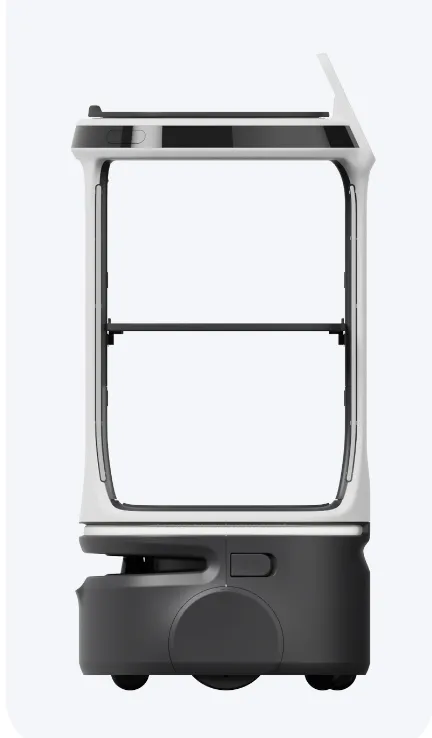
The Servi Plus carries up to 88 lbs (40 kg) across four trays and can handle 16 entrees per run, with an active suspension and a liquid-delivery algorithm that keeps soup and drinks stable at speed. Bear Robotics' field team installs and maps the robot on-site in 2–3 days, and all software, maintenance, and support are included in the subscription. It integrates with multi-robot orchestration to avoid deadlocks during peak service. The tradeoff: it runs food to tables and retrieves dishes, but it does not take orders or replace front-of-house judgment. Works best in higher-volume restaurants with consistent floor plans.
Pudu Robotics
BellaBot Pro
Model: BellaBot Pro
Pudu's BellaBot Pro combines delivery (40 kg payload, four trays, 11-hour battery) with an 18.5-inch advertising LCD and a 10.1-inch interactive touchscreen, making it useful in restaurants and hotels that want to run promotional content alongside service. Its VSLAM+ navigation deploys faster than magnetic-tape systems. For operators who want a lower-cost runner without the ad screen, the original BellaBot (reported ~$15,900 purchase) is a proven alternative. HolaBot, also from Pudu, offers a 60 kg / 120-liter capacity with a built-in pager system for high-volume bussing. All three are widely deployed across North America, Europe, and Asia.
Avidbots
Avidbots Neo
Model: Neo
Avidbots Neo (and the newer Neo 2W) is among the most widely deployed autonomous floor scrubbers in large facilities, with documented use in airports, warehouses, malls, manufacturing plants, and universities. It runs approximately four hours per charge on standard configurations. Avidbots deploys, maps, and maintains the fleet remotely, so facilities teams are not responsible for software updates or troubleshooting. Tennant's T7AMR (built on Brain Corp's OS) is a strong alternative for medium-sized facilities with tighter budgets, with a 26-inch cleaning path and up to 13 hours of daily operation via opportunity charging. Gausium's Phantas is worth evaluating for sites that need a compact 4-in-1 unit (vacuuming, sweeping, scrubbing, dust mopping) in a single machine.
Relay Robotics
Relay
Model: Relay
Relay Robotics (formerly Savioke) holds an established position in hotel delivery robotics, with documented deployments at Marriott, Hilton, Westin, Mandarin Oriental, Holiday Inn, and Radisson properties. The Relay2 doubles the capacity of earlier models at 10 gallons. The robot navigates hallways and elevator banks autonomously, texting guests when it arrives, then returns to the service floor on its own. Installation time is measured in days, not months, with no elevator wiring required. Pudu's KettyBot (reported from ~$9,500 purchase or ~$395/mo RaaS) is a lower-cost option that combines delivery, reception, and digital signage functions and suits smaller hotels or limited-service properties.
Knightscope
K5
Model: K5
The Knightscope K5 is one of the most widely recognized autonomous outdoor security robots in the US market, deployed at commercial campuses, parking structures, shopping centers, and stadiums. At roughly 5 feet tall, it carries 360-degree cameras, thermal imaging, LiDAR, air quality sensors, and anomalous wireless signal detection. Knightscope markets it at approximately $11/hour versus $35–$85/hour for a human guard, though that comparison sets aside the robot's limitations: it cannot intervene physically, it detects and reports rather than responds, and its value depends on whether your security model is deterrence and documentation rather than active response. Contracts run 12–36 months. In March 2026, Knightscope acquired Event Risk to add human guard services alongside its robot fleet.
Locus Robotics
LocusBot
Model: LocusBot
Locus Robotics has logged more than 6 billion robot-assisted picks across its customer base, and its Origin AMR is designed to work alongside human pickers rather than replace the facility layout. Pickers walk shorter routes while LocusBots handle transport between pick zones and packing stations, improving picks-per-hour in documented deployments. The RaaS model covers hardware, software, deployment, and ongoing support. For operations exploring humanoid robotics in warehousing, Agility Robotics' Digit is entering commercial deployment (Mercado Libre, GXO Logistics, Amazon have used it) with a focus on tote handling and tasks that previously required facility redesign for fixed automation. Digit is enterprise-contract only, not self-serve.
Simbe Robotics
Tally 4.0
Model: Tally 4.0
Simbe unveiled Tally 4.0 in January 2026 with ultra-high-resolution imaging, up to 12 hours of runtime, edge AI via NVIDIA hardware, and dual fisheye cameras for 360-degree context capture. Tally autonomously scans aisles multiple times per day, flagging out-of-stocks, pricing errors, and misplaced items in near real time. Simbe became the first retail robotics company to achieve UL 3300 certification in 2025. Recent deployments include Harmons (17 locations), Theisen's, HomeBase USA, and DeCicco & Sons. Tally does not restock shelves; it generates intelligence that staff act on. Retailers that do not have a reliable process for acting on out-of-stock alerts will not see the full return.
Universal Robots
UR5e / UR10e
Model: UR5e / UR10e
Universal Robots' UR series cobots are among the most widely deployed collaborative robot arms for small and mid-size manufacturers globally. The UR5e (5 kg payload) and UR10e (10 kg payload) are appropriate starting points for screw driving, assembly, pick-and-place, and machine tending. The arm is only part of the cost: end effectors, vision systems, safety guarding, and programming typically double the hardware price. See our full guide to assembly-line robots for detailed cobot selection, integration, and ROI guidance.
Most business owners asking “should I get a robot?” are really asking a narrower question: is there a specific robot that would actually solve a specific problem I have, at a cost that makes sense? This guide is organized around that question. Rather than surveying every category of commercial robotics, it focuses on the use cases where robots have moved past the demo phase into real, multi-site deployments, and where the economics work for an actual business, not just an enterprise pilot.
The dominant commercial model in 2026 is Robot-as-a-Service, covered below before we get into specific categories.
How Robot-as-a-Service Works (and Why It Matters)
Nearly every vendor in this guide offers their product through a RaaS subscription rather than outright sale as the primary path for new customers. Under a typical RaaS agreement, you pay a fixed monthly fee that covers the robot hardware, deployment and mapping, software updates, maintenance, and technical support. The analogy to SaaS is useful: you are paying for a capability, not owning an asset.
This model exists for two reasons. First, it lowers the entry barrier for businesses that cannot justify a $50,000 capital expenditure on an unproven technology. Second, it transfers maintenance responsibility to the vendor, which matters when a robot that goes offline for two weeks represents a real operational problem.
The tradeoff: over a three-to-five year horizon, RaaS is almost always more expensive than purchase. If you run the numbers at the end of a 36-month contract, you may have paid 1.5x–2x the unit’s purchase price. The RaaS premium is worth it for businesses that want the vendor to own the risk of the technology working, and for buyers who are not ready to build internal robotics operations expertise.
ProServBots’ overview of RaaS pricing models covers what subscriptions typically include and what is usually excluded (physical damage, consumables, and site-specific modifications are common exclusions).
Restaurants and Hospitality
Restaurant robots are real, and they are solving a real problem: finding and keeping reliable staff for the repetitive work of running food and bussing tables. They are not solving the entire labor problem, and the marketing sometimes outruns the reality.
Bear Robotics Servi and Servi Plus
Bear Robotics has been deploying service robots in restaurants since 2019, and the Servi Plus is its high-capacity flagship: 88 lbs (40 kg) payload, four trays, up to 16 entrees per run. An active suspension system and a liquid-delivery algorithm handle soup and open beverages at speed without spilling. The robot navigates autonomously, integrates with multi-robot orchestration, and Bear’s field team handles installation and mapping in 2–3 days on-site.
In May 2026, Bear introduced the Servi Q, a narrower-profile robot developed with SoftBank Robotics for tight spaces and high-traffic environments, expanding the use case into venues where the Servi Plus footprint does not fit.
Pricing through resellers like RobotLAB is reported from approximately $293/month under RaaS programs. Deployment costs and full subscription pricing vary by site; contact Bear Robotics directly for a deployment quote.
Pudu Robotics: BellaBot, BellaBot Pro, HolaBot
Pudu is among the most widely deployed restaurant robot brands globally. The BellaBot Pro adds a 18.5-inch advertising LCD and 10.1-inch interactive touchscreen to the standard four-tray, 40 kg platform, with VSLAM+ navigation that deploys faster than magnetic-tape systems and an 11-hour battery. The standard BellaBot is reported at approximately $15,900 to purchase or around $2,430/month on a RaaS lease.
For high-volume bussing environments, the HolaBot offers 60 kg capacity and 120 liters of space across four trays, with a built-in pager that allows staff to call and assign tasks to the robot by voice. KettyBot Pro is positioned as a 3-in-1 runner, reception, and marketing robot, reported from around $9,500 purchased or $395/month via RaaS.
Where these robots work best: restaurants with consistent floor plans, predictable traffic patterns, and a clear runner workflow. Where the fit weakens: small venues with tight corners, irregular table arrangements, or service styles that require frequent human judgment.
Commercial Cleaning and Facilities Management
Autonomous floor scrubbing is one of the most commercially mature segments in service robotics. The core value proposition is simple: an overnight cleaning shift that used to require a human operator can now run autonomously, and the robot does not call in sick. Vendors have been iterating on this category for nearly a decade, and the deployments are large-scale and well-documented.
Avidbots Neo
Avidbots Neo is one of the most widely deployed autonomous floor scrubbers in large-format facilities, with documented use in airports, logistics centers, shopping malls, and universities. The Neo 2W is the current primary model, and Avidbots runs its fleet remotely, handling software updates, performance monitoring, and diagnostic response without requiring on-site IT resources from the customer.
Purchase pricing is reported around $50,000 per unit; RaaS monthly lease rates are reported in the $800–$2,000 range per month, varying by site complexity and contract length. Service plans for purchased units run approximately $500/month.
Tennant T7AMR
Tennant’s T7AMR runs on Brain Corp’s autonomous OS and is suited for medium-sized facilities that do not need the Neo’s large-format footprint. Its 26-inch cleaning path covers warehouses, distribution centers, food processing floors, and educational facilities. The lithium-ion battery runs 5–6.5 hours per charge, with opportunity charging extending daily coverage to up to 13 hours. Tennant announced its 10,000th autonomous mobile robot sold, which signals a meaningful installed base for parts and service support.
Gausium Phantas
For facilities that need a single machine to handle multiple floor types, Gausium’s Phantas integrates vacuuming, sweeping, scrubbing, and dust mopping in one compact unit. Its AI-powered obstacle recognition and auto spot cleaning mode (which scans for debris and diverts autonomously) make it well-suited to high-traffic public environments like airports and supermarkets. The Phantas handles its own docking, recharging, water refill, dirty water drainage, and self-cleaning after each run.
Hotels: Indoor Delivery Robots
Hotel delivery robots have a straightforward ROI case in limited-service and mid-scale properties: the robot handles the bulk of amenity and room-service delivery runs overnight and during peak periods, reducing the number of trips a front desk agent makes per shift.
Relay Robotics
Relay Robotics, formerly Savioke, holds a well-established position in North American hotel robotics with documented deployments at Marriott, Hilton, Westin, Mandarin Oriental, Holiday Inn, and Radisson properties. The robot navigates hallways and elevator banks autonomously without requiring elevator wiring, sending a text to the guest room when it arrives, then returning to the service floor independently. The Relay2 model doubles the capacity of earlier units at 10 gallons.
Installation is measured in days. Pricing is contact-for-quote; the broader hotel delivery robot category is reported in the $1,000–$2,000/month range on lease models, with variations based on number of floors, building layout, and fleet size.
Pudu’s KettyBot Pro is worth evaluating as a lower-cost alternative for smaller properties, reported from around $9,500 to purchase or $395/month via RaaS, combining delivery, reception signage, and digital advertising in one unit.
Security and Patrol
Autonomous security robots are deployed primarily as deterrence and documentation tools. They patrol defined routes, capture video and sensor data, and flag anomalies for human review. Understanding this distinction before signing a contract is important: these are not guard replacements in the intervention sense.
Knightscope K5
The Knightscope K5 is among the most widely deployed autonomous outdoor security robots in the US. Standing about five feet tall, it carries 360-degree cameras, thermal imaging sensors, LiDAR, radar, air quality sensors, and detection for suspicious wireless signals. It operates continuously on outdoor patrols across commercial campuses, parking structures, shopping centers, hospitals, and stadiums.
Knightscope markets the K5 at approximately $11/hour versus $35–$85/hour for a human security guard. That cost comparison is real. What it sets aside: the robot cannot detain anyone, cannot respond to a confrontation, and cannot make judgment calls in ambiguous situations. Its value is clearest in high-visibility deterrence environments (parking lots, perimeter patrol) and in documentation-heavy contexts (continuous video capture, incident logging). For security programs that rely on active human response, the K5 is a complement to guards, not a substitute.
Contracts run 12–36 months under Knightscope’s RaaS structure. In March 2026, Knightscope acquired Event Risk, a national security staffing firm, positioning itself to offer blended robot-and-human guard programs.
Warehouse and Logistics
Warehouse robotics is the most commercially mature category in this entire guide, with deployments ranging from single-site pilot programs to multi-facility fleets of 100+ robots. The economics are strongest in high-labor-cost markets with repetitive, predictable workflows.
Locus Robotics (LocusBot)
Locus Robotics has logged more than 6 billion robot-assisted picks across its deployments, reaching that milestone with the final billion completed in 24 weeks, suggesting strong utilization in its active fleet. The LocusBot Origin AMR works alongside human pickers: humans pick individual items while the robot handles the transport between pick zones and packing or consolidation stations. This reduces the distance each picker walks per shift and improves picks-per-hour without requiring a full facility redesign.
RaaS pricing is reported at approximately $1,500/robot/month for the Origin. Locus also offers an “Array” automation product through its existing RaaS subscription. The median new AMR deployment has grown from 15 robots per facility in 2024 to approximately 35 as of 2026, per industry data, as customers move from pilots to full production deployments.
Agility Robotics Digit
Agility Robotics’ Digit occupies a different tier: a humanoid robot focused on tote handling and locomotion in unmodified warehouse environments. Digit has been used by Amazon, GXO Logistics, and Schaeffler, and completed a commercial deployment agreement with Mercado Libre for a San Antonio warehouse in 2026. Digit has moved more than 100,000 totes in live commerce operations according to Agility. It is not self-serve or available outside enterprise partnerships, and pricing is enterprise-contract only.
Autonomous Forklifts
For heavier material handling, autonomous forklifts (often called autonomous guided vehicles or AGVs) handle pallet movement, inbound receiving, and put-away in structured warehouse environments. Purchase pricing is reported from $40,000–$85,000 for standard autonomous counterbalance models, with fully autonomous narrow-aisle systems exceeding $200,000. A fleet of five units lands in the $450,000–$600,000 range when integration, fleet management software, and charging infrastructure are included. RaaS models are available from several vendors in this category. Contact vendors including SEER Robotics, VisionNav, and Jungheinrich for site-specific quotes.
Retail: Inventory and Shelf Intelligence
Simbe Robotics Tally 4.0
Simbe unveiled Tally 4.0 in January 2026, the most advanced generation of its shelf-scanning platform, with availability to customers from mid-2026. The 4.0 generation adds up to 12-hour runtime, NVIDIA CUDA/TensorRT edge compute for onboard AI processing, ultra-high-resolution imaging for small and recessed labels, dual fisheye cameras for 360-degree store context, and support for additional fixture types including bunkers. Simbe also became the first retail robotics company to achieve UL 3300 safety certification.
Tally scans aisles autonomously multiple times per day, surfacing out-of-stocks, pricing discrepancies, and misplaced items for staff to act on. Recent deployments include Harmons across all 17 of its locations following a pilot, Theisen’s Home Farm & Auto, HomeBase USA, and DeCicco & Sons. Annual deployment cost is reported at approximately $30,000–$50,000 per store covering hardware lease, software, and support.
The honest scope on Tally: it generates inventory intelligence. The ROI depends entirely on what your team does with that intelligence. Retailers without a reliable process for acting on out-of-stock alerts within a few hours will not realize the full benefit.
Small Manufacturing: Collaborative Robot Arms
Collaborative robot arms (cobots) are covered in this section briefly because they belong in the business-robot conversation. But the topic is broad enough that we have given it its own dedicated guide.
Universal Robots is among the most widely deployed cobot brands globally, with the UR5e (5 kg payload) and UR10e (10 kg payload) being common starting points for small and mid-size manufacturers doing assembly, screw driving, machine tending, and pick-and-place. The UR5e arm is reported at $30,000–$40,000 for the arm alone; a fully integrated cell including end effector, vision system, safety guarding, and programming typically lands at $50,000–$150,000.
If you run a factory or production line, see our guide to the best assembly-line robots in 2026 for detailed cobot selection, integration timelines, ROI analysis, and what to ask your integrator before committing.
An Honest Take on ROI
Across every category in this guide, the vendors are selling optimism and the reality is more conditional.
The categories where the economics work most reliably in 2026 are: warehouse AMR picking (predictable workflow, measurable picks-per-hour lift, multi-year deployment track record), commercial floor scrubbing (replaces a specific, repetitive overnight shift that is hard to staff consistently), and retail inventory scanning (clear data output, measurable reduction in out-of-stocks when the process side is in place).
The categories where the marketing outruns the reality: security robots do not replace guards, they augment deterrence. Restaurant robots reduce server walking distance but do not fix underlying staffing economics. Hotel delivery robots help during constrained periods but require reliable elevator navigation and floor plans that do not frequently change.
The variables that matter more than the robot hardware: local labor costs (the ROI math is almost always stronger above $18–$20/hour), floor plan stability (robots that need to be remapped frequently add hidden operational costs), staff buy-in (robots fail faster in environments where staff route around them), and what you do with the data the robot surfaces.
A realistic payback horizon for a well-matched RaaS deployment is 12–24 months in a high-labor-cost market with a predictable workflow. In markets with lower labor costs or more complex environments, plan for longer or rethink the ROI model entirely.
Frequently asked questions
What does a business robot actually cost?
Should I buy the robot outright or use a RaaS subscription?
Do these robots actually replace staff, or do they work alongside them?
How reliable are commercial robots, and what happens when they break?
What is the realistic ROI timeline for a business robot?
What about service and repair after deployment?
Are there categories where the marketing clearly oversells the technology?
Sources
Every claim in this guide that isn't first-person experience is traceable to one of the sources below. URLs verified at publication; some may rot. Let us know if so.
- Servi Plus: Bear Robotics' Flagship AI Service Robot for Hospitality and Beyond · Bear Robotics, 2026Primary source for Servi Plus payload specs (88 lbs / 16 entrees), liquid delivery algorithm, and active suspension.
- Bear Robotics Introduces Servi Q: the Compact Service Robot That Goes Where Others Can't · Morningstar / AccessWire, May 2026Confirms Servi Q launch at NRA Show 2026; context for Bear Robotics product line evolution.
- Bear Robotics Servi+ | RobotLAB · RobotLAB, 2026Source for reported RaaS pricing from $293/mo through reseller channel.
- BellaBot Pro | Pudu Robotics · Pudu Robotics, 2026Primary source for BellaBot Pro specs: 40 kg payload, 11-hour battery, 18.5-inch LCD, VSLAM+ navigation.
- Pudu Robotics BellaBot Price and Specifications · TodoRobotics, 2026Source for reported BellaBot purchase price (~$15,900) and RaaS pricing (~$2,430/mo).
- Autonomous Floor Cleaning Robot | Avidbots · Avidbots, 2026Primary source for Neo product overview and use case categories (airports, warehouses, malls, manufacturing).
- Tennant T7AMR Robotic Floor Scrubber | Tennant Company · Tennant Company, 2026Source for T7AMR specs: 26-inch cleaning path, 13-hour daily operation via opportunity charging, Brain Corp OS.
- Phantas | Commercial Cleaning Robot | Gausium · Gausium, 2026Primary source for Phantas 4-in-1 cleaning modes, AI obstacle recognition, and auto spot cleaning claims.
- Relay Delivery Robots for Hotels · Relay Robotics, 2026Primary source for Relay hotel deployment capabilities, hotel brand list, and autonomous elevator navigation.
- Savioke is now Relay Robotics · The Robot Report, 2022Background on company rebranding from Savioke to Relay Robotics; confirms transfer of customer agreements.
- K5 Autonomous Security Robot | Knightscope · Knightscope, 2026Primary source for K5 sensor suite, deployment environments, and product overview.
- Knightscope on X: K5 pricing approximately $11/hour · Knightscope (official X account), 2026Source for Knightscope's own $11/hour pricing claim versus $35–$85/hour guard comparison.
- The ROI of Warehouse Robots-as-a-Service (RaaS) · Locus Robotics, 2025Source for Locus RaaS model structure and ROI claims. Vendor-authored; treated as primary with caveat.
- Agility Robotics and Mercado Libre Announce Commercial Agreement · Agility Robotics, 2026Source for Digit commercial deployment at Mercado Libre Texas warehouse; confirms enterprise-contract model.
- Simbe Unveils Tally 4.0: The Next Generation of Autonomous Retail Robot · PR Newswire / Simbe Robotics, January 12, 2026Primary source for Tally 4.0 launch specs: 12-hour runtime, NVIDIA edge compute, dual fisheye cameras, mid-2026 availability.
- Simbe Becomes First Retail Robotics Company to Achieve UL 3300 Certification · PR Newswire / Simbe Robotics, 2025Source for Simbe's UL 3300 safety certification claim.
- Universal Robots Pricing Guide · Universal Robots, 2026Primary source for UR cobot pricing context and total system cost considerations.
- RaaS Pricing Models Explained: How Robotics-as-a-Service Pricing Works · ProServBots, 2026Background on RaaS model structure, what subscriptions typically include, and pricing variation by category.