Buyer's guide · business robots
Best Assembly Line Robots in 2026: Industrial Arms, Cobots, and the Humanoid Shift
The honest buyer's guide to factory robots in 2026: traditional industrial arms, collaborative cobots, and the humanoid entrants actually on real lines.
Disclosure: We earn commissions from links on this page, as an Amazon Associate we earn from qualifying purchases, at no extra cost to you. This never affects what we recommend. Read our editorial standards →
FANUC
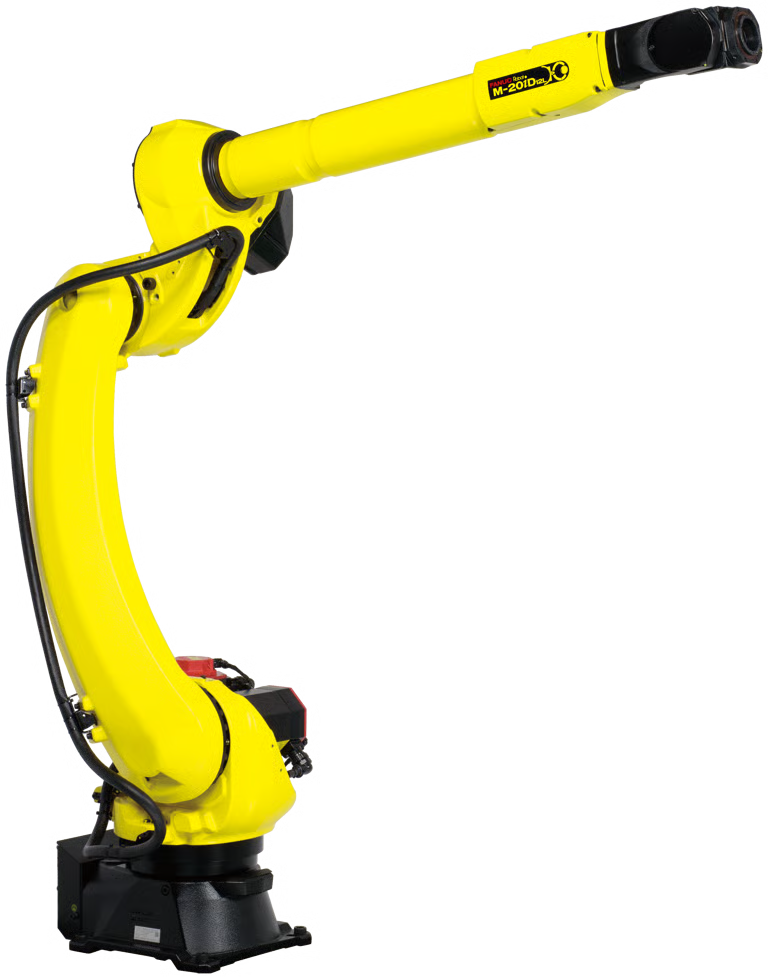
M-20iD/12L
Model: M-20iD/12L
FANUC holds the largest global market share of any industrial robot brand (roughly 17% as of 2025), and the M-20iD/12L is the workhorse of that lineup: a 12 kg payload arm with a 2,272 mm reach and a repeatability of ±0.02 mm that suits everything from press tending to general assembly. FANUC's controller ecosystem is among the most widely integrated globally, which means integrators, spare parts, and trained technicians are easy to source. The caveat is cost: the arm alone is typically quoted around $40,000 new, and a complete deployed cell with safety enclosure, tooling, and integration labor runs $100,000–$200,000 or more depending on complexity. List prices vary by region and configuration; request a quote through a FANUC America certified integrator.
ABB
IRB 6700-235/2.65
Model: IRB 6700-235/2.65
ABB and KUKA are the dominant brands in automotive body-in-white and heavy spot-welding applications, and the IRB 6700 is ABB's purpose-built answer for that segment. The 235 kg payload variant handles heavy spot-welding guns without compromise; repeatability is ±0.04 mm on a 2,650 mm reach. ABB claims a 20% reduction in total cost of ownership versus the prior generation, driven by longer service intervals and a 15% reduction in power consumption. This is a caged system designed for high-volume automotive production, not SMB or collaborative use. Pricing is not published; estimates from trade sources run $75,000–$120,000 for the arm, with a full welding cell integration costing substantially more.
Universal Robots
UR10e
Model: UR10e
Universal Robots is the segment-defining cobot brand, and the UR10e is the sweet spot of the lineup: a 12.5 kg payload, 1,300 mm reach, and ±0.05 mm repeatability at a published base price around $48,600. It operates without a safety cage in collaborative mode (subject to a completed risk assessment under ISO 10218-2:2025), which dramatically reduces footprint and integration cost versus caged industrial arms. The UR+ ecosystem of certified end-effectors and software accelerates deployment. Typical total cell cost runs $80,000–$130,000 installed. Note that Universal Robots is refreshing model names in 2025: the UR10e becomes the UR12e in the updated lineup, and the UR5e becomes the UR7e; specs remain comparable.
Universal Robots
UR30
Model: UR30
The UR30 pushes collaborative robot payloads to 30 kg, which covers a class of machine-tending, palletizing, and heavy-assembly tasks that previously required a caged industrial arm. At 1,300 mm reach and ±0.05 mm repeatability, it fits into the same UR ecosystem as smaller models, meaning integrators familiar with UR cobots can scale up without retraining. The UR20 (20 kg, 1,750 mm reach) is the better choice for tasks requiring longer reach over raw payload. Pricing for the UR30 is not uniformly published; distributor quotes are the reliable route. For the very heaviest collaborative payload needs, the new UR15 (15 kg, 1,300 mm, 5 m/s top speed) is an alternative if speed matters more than payload mass.
Techman Robot
TM12 (TM S Series)
Model: TM12 (TM S Series)
Techman's TM S Series cobots are among the most affordable vision-equipped collaborative arms available, with the 12 kg payload TM12 typically quoted around $34,000. The built-in camera and AI vision system eliminates the need for a separate third-party vision solution, which can reduce integration cost and complexity for smaller manufacturers. Techman showcased new AI cobot innovations at Automate 2025, with the TM6S introducing a 1,800 mm reach at just 35.5 kg robot weight. Repeatability on the S Series is ±0.03 mm. The tradeoff versus Universal Robots is a smaller ecosystem and fewer certified integrators in the US market, but the value proposition for SMBs running electronics assembly, inspection, or light pick-and-place is strong.
Yaskawa Motoman
AR2010
Model: AR2010
Yaskawa Motoman commands roughly 12% of the global robotics market and its AR series is purpose-built for arc welding. The AR2010 offers a 12 kg payload, 2,010 mm reach, ±0.03 mm repeatability, and a hollow-arm design that routes the welding torch cable internally to prevent snag and collision. It runs on the YRC1000 controller, which includes welding-specific functions. At $90,000–$120,000 new for the arm alone (plus welding equipment and integration), this is not a budget pick. But for automotive frames, agricultural equipment, and structural welding at volume, it is one of the most field-proven dedicated arc-welding systems available. Caged installation required.
Figure AI
Figure 03
Model: Figure 03
Figure AI is among the most documented humanoid deployments on real factory lines as of mid-2026. Its predecessor, Figure 02, completed an 11-month project at BMW Spartanburg contributing to 30,000+ X3 vehicles, logging 90,000+ parts loaded across 1,250+ hours. Figure 03 is now in production ramp at BotQ, which scaled from 1 robot/day to 1 robot/hour in under four months, with 350+ units delivered. The commercial model is Robot-as-a-Service, not unit sales. The honest constraint: humanoids on assembly lines today perform narrow, structured tasks (sheet-metal loading, pick-and-place) in controlled environments. They are not general-purpose drop-in workers, and deployment involves significant process engineering. For most buyers, this is a vendor relationship, not a product purchase.
Factory floors in 2026 offer three very different answers to the question “which robot should build my product?” The right choice depends almost entirely on the gap between your production volume, your budget, and your tolerance for integration complexity.
The first tier is the traditional industrial robot arm: high-speed, high-precision, caged behind safety barriers, and proven across decades of automotive and electronics manufacturing. These are the systems from FANUC, ABB, KUKA, and Yaskawa (Motoman) that account for the vast majority of the 542,000 industrial robots installed globally in 2024, according to the International Federation of Robotics. China alone took 54% of those installations (295,000 units), the highest annual total ever recorded. If you run a high-volume, structured process and can justify the capital and floor space, this tier is where you get the best repeatability and throughput per dollar of arm cost.
The second tier is collaborative robots, or cobots. Introduced commercially in the early 2010s, cobots use Power and Force Limiting technology and rounded designs to operate near people without a full safety cage, subject to a risk assessment. They are slower and generally lower payload than industrial arms, but the integration cost and footprint are substantially reduced. Universal Robots remains the global share leader in this segment; Techman, FANUC’s CRX series, Yaskawa’s HC series, and a growing cohort of Asian brands round out the market. For small and mid-size manufacturers, a cobot cell is often the realistic entry point.
The third tier is humanoid robots. A handful of companies have graduated from demo videos to actual factory deployments: Figure AI at BMW, Tesla Optimus inside Fremont, UBTECH Walker S2 at BYD and other Chinese plants, and Apptronik Apollo at Mercedes-Benz. These deployments are real and documented. But they are also narrow: humanoids on assembly lines today handle structured pick-and-place tasks in prepared environments, not general labor. They are sold as Robot-as-a-Service commercial contracts, not off-the-shelf capital equipment. For most buyers evaluating production capacity as of June 2026, humanoids are a watch-closely category, not a buy-now one.
How to Think About the Buying Dimensions
Payload and Reach
Payload is the combined weight of the workpiece and the end-of-arm tool the robot must move; build in a 10–20% margin above your heaviest expected load. Reach must cover the full arc from the robot’s mounting base to the farthest point the tool travels, again with margin. These two numbers narrow your options faster than any other spec.
For light electronics assembly under 3 kg: a UR7e-class cobot or KUKA KR AGILUS (4–10 kg payload, $25,000–$35,000 arm) covers the range. For general assembly and machine tending in the 5–15 kg range: the UR10e or FANUC M-10iD/12 (12 kg payload, ±0.02 mm repeatability) are the workhorses. For heavy machine tending and palletizing at 20–30 kg: the UR20, UR30, and FANUC CRX-30iA extend cobots into territory that previously required caged industrial arms. Above that, caged systems from ABB, KUKA, and Yaskawa handle payloads from 100 kg to over 1,000 kg.
Repeatability
Repeatability is not the same as accuracy. It measures how consistently the robot returns to the same taught position, not whether that position is exactly where you intended. For electronics assembly and precision fastening, you typically need ±0.02–0.05 mm. For machine tending and palletizing, ±0.1 mm is usually acceptable. All seven picks in this guide meet ±0.05 mm or better; the FANUC M-20iD/12L achieves ±0.02 mm.
Safety: Caged vs. Collaborative
The practical difference is integration cost and footprint. A caged industrial robot requires physical barriers (fences, light curtains, or safety scanners), safety-rated interlocks, and access control. That infrastructure adds cost and floor space. A collaborative robot operating in “collaborative mode” can share space with people without a full cage, but this requires a formal risk assessment under ISO 10218-2:2025 (which now incorporates the guidance formerly in ISO/TS 15066 on force limits and shared workspaces). In the US, ANSI/RIA R15.06 is the aligned domestic standard. Not every cobot application is cage-free in practice; many cobot deployments use partial guarding or reduced-speed zones. “Cobot” describes a capability, not a guarantee.
Price, Plus Integration
The arm price is only the beginning. A complete deployed robot cell typically costs 1.5–3x the arm price once tooling, integration labor, safety infrastructure, and commissioning are included. Industry cost guides for 2026 put a realistic mid-payload caged cell at $100,000–$200,000 installed, and a cobot cell at $80,000–$130,000. Over a 7-year operating horizon, total cost of ownership runs 1.8–2.5x the initial capital figure once maintenance, downtime, and spare parts are counted. Request installed-cell quotes from certified integrators, not just arm prices from distributors.
Programming Effort
Traditional industrial robots are programmed via teach pendant or offline simulation software (FANUC’s ROBOGUIDE, ABB’s RobotStudio, Kuka’s KUKA.Sim), which requires skilled programmers. Cobots have shifted this significantly: Universal Robots’ PolyScope interface and FANUC CRX’s drag-and-drop touchscreen teaching reduce the barrier for smaller manufacturers. No-code programming is not a guarantee, but the gap between industrial and collaborative robot programming has narrowed substantially in recent years. Humanoid robots are currently programmed through a combination of teleoperation, imitation learning, and reinforcement learning; deployment requires specialists, not line workers.
Tier One: Industrial Arms
FANUC: Market Leader, Massive Ecosystem
FANUC’s dominance is partly a function of scale: the company holds roughly 17% of global market share, which translates into the broadest integrator network and spare-parts availability of any brand. The M series covers small-to-mid payload (the M-10iD/12 at 12 kg, 1,441 mm reach, ±0.02 mm repeatability; the M-20iD at 12 kg with a longer 2,272 mm reach). For higher payloads, the M-710 and M-900 series reach up to 700 kg. FANUC does not publish list prices; quotes come through certified integrators. Third-party cost guides report the M-20iD in the $40,000 range as a starting point for arm-only pricing, with complete cells substantially higher.
ABB: Automotive Welding and High Repeatability
ABB is particularly strong in automotive body-in-white and spot welding. The IRB 6700 family (150–300 kg payload, 2.6–3.2 m reach) is one of the benchmarks for heavy automotive assembly. ABB’s FlexArc welding cells are among the most widely deployed turnkey solutions in the industry. The company also offers the GoFa and SWIFTI collaborative robot lines for lighter applications.
KUKA: Strong in Europe, Automotive Focus
KUKA (owned by Midea Group since 2016) maintains roughly 5% global market share and a strong footprint in European automotive manufacturing. The KR QUANTEC handles 120–300 kg payloads for heavy automotive work; the KR AGILUS at 4–10 kg and $25,000–$35,000 covers compact electronics and small-parts assembly. KUKA’s KR C5 controller is well-regarded for integration flexibility.
Yaskawa Motoman: Arc Welding Specialty
Yaskawa commands roughly 12% of the global robotics market through its Motoman division. The AR series (dedicated arc welding, 6–15 kg payload) is the strongest industrial welding portfolio of the big four, with the AR2010’s hollow-arm design routing torch cabling internally to prevent collision in dense weld cells.
Tier Two: Collaborative Robots
Universal Robots: The Benchmark
Universal Robots essentially created the commercial cobot category and remains the benchmark for ease of deployment and ecosystem breadth. The current lineup spans from the UR3e (3 kg, 500 mm reach) through the UR20 (20 kg, 1,750 mm reach) and UR30 (30 kg, 1,300 mm reach). In May 2025, Universal Robots introduced the UR15 at Automate 2025: 15 kg payload (upgradable to 17.5 kg for vertical applications), 1,300 mm reach, 5 m/s top speed, and IP65 protection. The UR+ ecosystem of certified third-party end-effectors and applications is the largest in the cobot segment. Universal Robots is also refreshing model names: the UR5e becomes the UR7e, and the UR10e becomes the UR12e, with payload adjustments; the UR20 and UR30 remain.
FANUC CRX: Industrial Reliability, Cobot Simplicity
FANUC’s CRX series brings the company’s “8 Years Zero Maintenance” reliability claim into a collaborative form factor. The CRX-10iA/L (10 kg payload) and CRX-20iA/L (20 kg payload, 1,418 mm reach) are the most widely deployed models. FANUC cobot pricing is not published; third-party guides report the CRX-10iA around $43,000 and the CRX-20iA/L around $58,000. The CRX runs standard 120V power and uses a drag-and-drop touchscreen teach pendant that lowers the programming barrier compared to traditional FANUC pendant programming.
Techman Robot: Vision Included, Lower Entry Cost
Techman’s TM S Series integrates a camera and AI vision system directly into the robot arm, eliminating a common add-on cost. The TM12 (12 kg payload) is quoted around $34,000, making it among the more affordable vision-equipped cobots in this payload class. Repeatability is ±0.03 mm. The new TM6S, shown at Automate 2025, offers a 1,800 mm reach at 35.5 kg robot weight. The tradeoff is a smaller US integrator ecosystem than Universal Robots.
Yaskawa HC Series and Others
Yaskawa’s HC series (HC10DTP: 10 kg payload, 1,379 mm reach, ±0.05 mm repeatability, IP67 rated) targets machine tending and assembly where contamination or washdown is a concern. Doosan, AUBO, and Elephant Robotics offer additional options at lower price points, particularly competitive in Asian markets. These brands are worth evaluating for SMBs comfortable with a shorter US support network.
Tier Three: Humanoids on Real Lines
The honest framing for humanoid robots in manufacturing in 2026: the deployments are real, the tasks are narrow, and the commercial model is service contracts rather than capital equipment.
Figure AI has the most publicly documented production deployment. Figure 02 completed an 11-month project at BMW’s Spartanburg plant, contributing to more than 30,000 BMW X3 vehicles by handling sheet-metal loading across 1,250+ hours of runtime. Figure 03 is now in production ramp at the BotQ facility, which scaled to one robot per hour in under four months. BMW’s first German humanoid deployment, a Leipzig pilot announced in February 2026, uses a different robot (AEON by Hexagon Robotics), not Figure. The commercial structure is RaaS at roughly $25/operating hour.
Tesla Optimus has the largest single humanoid fleet in any one company’s factories, with over 1,000 Gen 3 units working at Fremont on battery module assembly, parts kitting, and final assembly assist as of early 2026. This is an internal deployment; Tesla has not opened external sales or preorders as of mid-2026. Note that China’s export restrictions on rare earth magnets, imposed in April 2025, remain an unresolved supply chain risk for Optimus production.
Apptronik Apollo is piloting at Mercedes-Benz, GXO Logistics, and Jabil facilities, backed by $935M+ in Series A funding. Commercial quantities are targeted for 2027. A RaaS model is also offered.
UBTECH Walker S2 began mass production and delivery in late 2025, with orders exceeding 800 million yuan ($112M+). Deployments span BYD, Dongfeng, Geely, FAW-Volkswagen, and Foxconn facilities in China. UBTECH is targeting 5,000 annual units by 2026. This makes Walker S2 one of the highest-volume industrial humanoid programs shipping as of June 2026, though it is primarily a China-market story.
For production engineers evaluating humanoids today: engage with Figure AI or Apptronik through their enterprise channels, budget for a structured pilot in a specific, bounded task, and do not plan humanoid capacity as a substitute for conventional automation on a 12-month horizon.
Market Context
The IFR World Robotics 2025 report places 4,664,000 industrial robots in operational use worldwide at the end of 2024, up 9% year-on-year. Annual installations of 542,000 in 2024 marked the fourth straight year above 500,000 units. Asia accounted for 74% of new deployments; Europe 16%; the Americas 9%. Global installations are forecast to grow 6% to 575,000 units in 2025, with the 700,000-unit threshold projected before 2028. China’s 54% share of 2024 installations reflects both massive domestic manufacturing expansion and the cost competitiveness of Chinese robot OEMs, which are increasingly visible in global markets.
If you run a restaurant, store, warehouse, or hotel rather than a factory, see our guide to the most useful robots for a business in 2026.
Frequently asked questions
What is the difference between a traditional industrial robot and a cobot?
What does a robot actually cost, fully installed?
Can humanoid robots actually work a production line yet?
What safety standards govern cobots and industrial robots?
What is the typical lead time for a new industrial robot?
Which robot brands dominate the global market?
What payload and reach do I need for my application?
Sources
Every claim in this guide that isn't first-person experience is traceable to one of the sources below. URLs verified at publication; some may rot. Let us know if so.
- World Robotics 2025: Global Robot Demand in Factories Doubles Over 10 Years · International Federation of Robotics (IFR), 2025Primary source for 2024 global installation figures (542,000 units), China's 54% share, 4.66 million operational stock, and 2025 forecast of 575,000 units.
- Record of 4 Million Robots in Factories Worldwide · International Federation of Robotics (IFR), 2024IFR press release on global operational robot stock milestone.
- FANUC M-20iD/12L Product Page · FANUC America, 2025Manufacturer page for M-20iD/12L specs: 12 kg payload, 2,272 mm reach.
- FANUC Robot Prices: Cost, Models, and Buying Insights in 2026 · Standard Bots, 2026Third-party cost guide for FANUC pricing ranges; FANUC M-20iD ~$40,000 example; market share 17% figure sourced here.
- Universal Robots Price Guide 2026 · GrabaRobot, 2026UR5e ~$37,245, UR10e ~$48,623 price examples; UR model rename (UR5e to UR7e, UR10e to UR12e) confirmed.
- Meet the All-New UR15 · Universal Robots, May 2025Primary source for UR15 specs: 15 kg payload (17.5 kg vertical), 1,300 mm reach, 5 m/s top speed, IP65. Confirmed UR15 joins UR20 and UR30 in high-performance range.
- F.02 Contributed to the Production of 30,000 Cars at BMW · Figure AI, November 2025Primary source for BMW Spartanburg Figure 02 deployment: 90,000+ parts, 1,250+ hours, 30,000+ X3 vehicles.
- Ramping Figure 03 Production · Figure AI, April 2026BotQ facility producing 1 Figure 03/hour; 350+ units delivered; production scale-up timeline.
- BMW Group to Deploy Humanoid Robots in Production in Germany for the First Time · BMW Group Press, 2026BMW's first German humanoid pilot (Leipzig, February 2026). The Leipzig robot is AEON by Hexagon Robotics, not Figure.
- UBTECH Humanoid Robot Walker S2 Begins Mass Production and Delivery · PR Newswire / UBTECH, November 2025Walker S2 mass production start; 800 million yuan in orders; BYD, Foxconn, FAW-Volkswagen deployments.
- How Much Does an Industrial Robot Cost? Guide 2026 · EVS International, 2026Arm-only pricing range $25,000–$180,000; total cell cost $80,000–$400,000; TCO 1.8–2.5x capex.
- Robot Safety Standards Guide 2026: ISO 10218, ISO/TS 15066 and CE Compliance · GrabaRobot, 2026ISO 10218-2:2025 update incorporating former ISO/TS 15066 content on collaborative robot safety.