Buyer's guide · robot vacuums
Best Budget Robot Vacuum 2026
The best sub-$300 robot vacuums in 2026, why the self-emptying eufy C10 now beats the discontinued L60, and what budget money actually buys.
Disclosure: We earn commissions from links on this page, as an Amazon Associate we earn from qualifying purchases, at no extra cost to you. This never affects what we recommend. Read our editorial standards →
eufy (Anker)
eufy C10
Model: C10
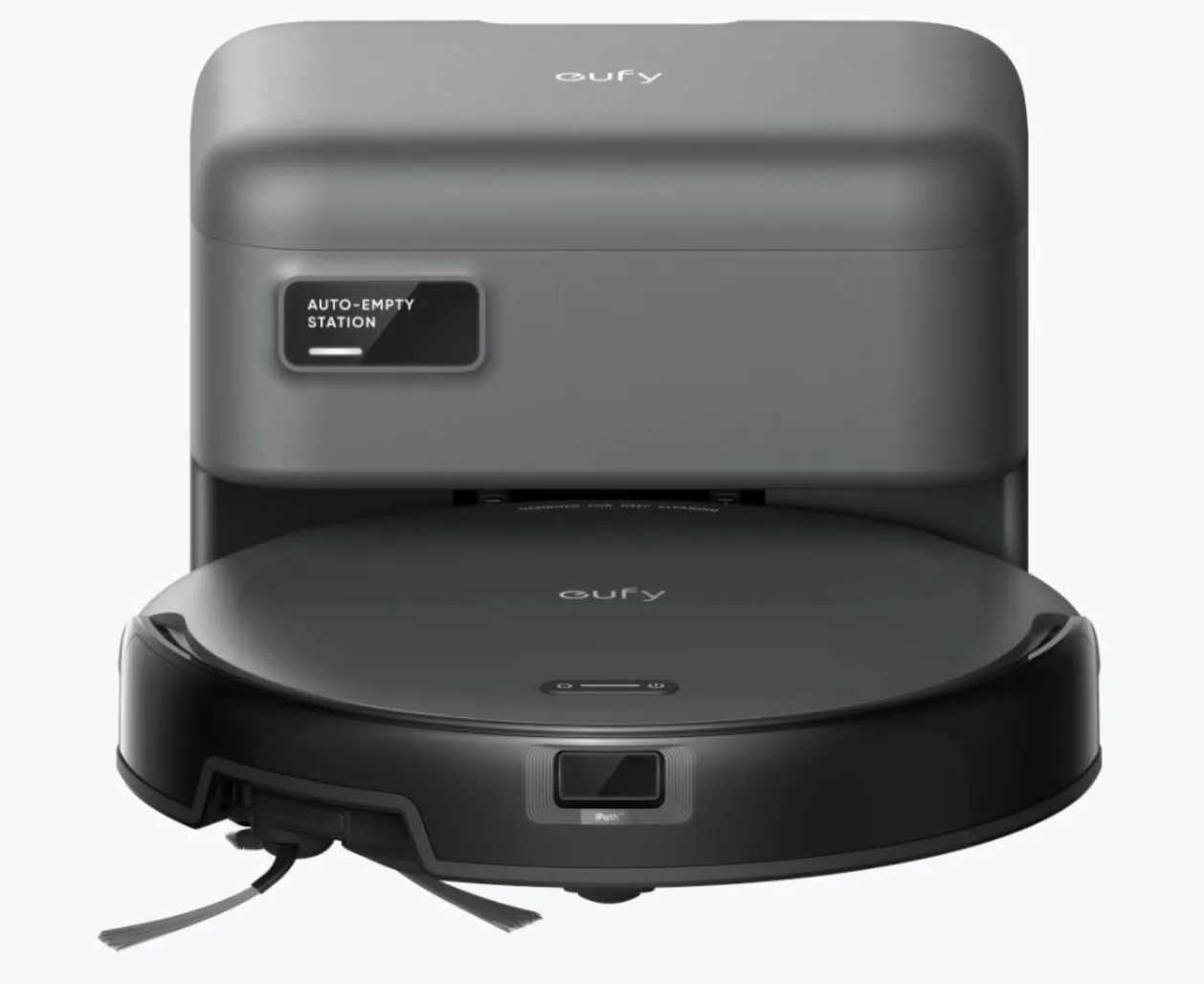
The pick to beat in 2026, and the model eufy itself steers former L60 buyers to. It pairs a self-emptying dock (a 3-liter bag rated for about 60 days) with an ultra-slim 2.85-inch body that fits under low furniture, plus 4,000 Pa suction. Two honest caveats. Its navigation is a single point-laser that eufy markets as LiDAR; Vacuum Wars scored its pathing slightly below average and distinguishes it from a full spinning-turret LiDAR, so mapping is good but not flawless. And it has no obstacle avoidance, so clear cords and socks before a run. Neither matters much when you are getting a self-emptying robot with real laser mapping for less than many docked-vacuums cost without a dock.
MOVA (Dreame sub-brand)
MOVA S10
Model: S10
Vacuum Wars' value standout for battery: they measured about 2.8 minutes of runtime per 1% of charge, roughly double the category average, and it swept up coffee grounds on both carpet and hard floors at under $200. Two caveats. It is the least independently tested of these three picks, so weight that single source accordingly. And MOVA is a newer Dreame sub-brand, so the cleaning is strong on paper but the multi-year US support and parts story is unproven, the same flag we put on every MOVA pick. One buying note: the S10 has largely disappeared from Amazon US, so we link MOVA's own store, where it sells for $169. Worth it if you have a larger single-level space that needs full coverage on one charge and you are comfortable closer to the bleeding edge.
eufy (Anker)
eufy L60
Model: L60
Be clear-eyed about this one: eufy discontinued the L60 in October 2025, and as of mid-2026 the new-unit stock is gone. What remains on Amazon is the certified-refurbished 'Renewed' version of the self-emptying SES model, which is what we link here; it is covered by the Amazon Renewed Guarantee rather than eufy's new-unit warranty, and eufy's own store sells certified refurbs too. It still works and still gets app updates. The L60 also shipped in three versions: the base L60 with no dock, the L60 SES with a self-emptying dock, and the L60 Hybrid with mopping; the hands-off one is the SES. Only worth it if the refurb price genuinely undercuts the C10 on sale and you do not mind owning a model that is being retired. Otherwise the C10 above is its supported successor.
The interesting story in robot vacuums in 2026 is not the $3,000 machines that climb stairs. It is how much capability has fallen into the budget tier. Two years ago, “budget robot vacuum” meant a puck that bounced off walls at random and gave up halfway through a two-bedroom apartment. Today, laser-based mapping and a self-emptying dock both show up under $300.
That changes the buying advice. The question is no longer whether a cheap robot vacuum is worth it. It usually is. The question is which corners the cheap ones still cut, and which model to trust now that the budget lineup has churned hard.
And it has churned. In the past year eufy discontinued both the 3-in-1 E20 and the popular L60, folding the budget range into its newer C-series (C10, C20, C28). That matters for a buyer, because half the “best budget” picks still floating around the web point at models that are now end-of-life. This guide centers on what you can actually buy today and will still be supported tomorrow.
What your money buys under $300
The single most important spec in this price range is navigation. Laser-mapping models build a map and clean in efficient back-and-forth rows. Models without it wander semi-randomly, get stuck more often, and leave gaps. In 2026 you can get laser navigation under $250, with one honest asterisk: at this price it is usually a single point-laser, which eufy and others still label “LiDAR,” rather than the spinning turret on pricier robots. Good, not flawless.
Suction in the 4,000 to 5,000 Pa range is now normal at this price and is plenty for hard floors and low-pile carpet. The newest budget development is the self-emptying dock dropping under $300, on the eufy C10. That feature used to start around $500. It does not clean any better. It just means you handle the dust every couple of months instead of every few days.
If you want more than the budget tier offers, the C10’s own siblings are the natural step up: the C20 adds a full Omni dock that washes and dries the mop pads, and the C28 swaps in a roller mop for wet messes. Both cost more and sit in our main guide rather than this one.
Where budget still falls short
Three things separate these from the mid-range, and they are worth being honest about.
Carpet and heavy pet hair. Budget models handle light jobs well, but the pet-hair claims at this tier do not all hold up. Independent testing is mixed, and some 2026 hands-on reviews found even the well-regarded L60 falls short on pet hair despite its bristled brush. For thick carpet or several shedding pets, mid-range robots pull clearly ahead. If pets are the reason you are buying, start with our pet-hair guide instead.
Mopping. Budget robots that “mop” mostly drag a damp pad. Real mopping, with pad washing and pressure, lives in the next tier up. If mopping matters, it is the clearest reason to spend more.
Obstacle avoidance. Most sub-$300 robots, the C10 included, have little or no obstacle avoidance. Tidy the floor before a run and it is a non-issue. Leave cords, socks, or a pet accident out and you will notice.
Who should skip budget and spend more
The most useful thing reviewers agree on in 2026 is that value peaks in the $300 to $1,000 range, not at the bottom. That is where laser mapping, a full self-emptying and mop-washing dock, and competent obstacle avoidance all arrive together. If you want mopping, have a lot of carpet, or simply want the machine you will not want to replace in a year, the budget tier is a false economy. Our main robot vacuum guide covers those picks.
But if your goal is hands-off floors at the lowest honest price, start with the eufy C10. It is current, it is supported, it self-empties, and it is cheaper than the discontinued L60 it replaced. Step to the MOVA S10 only if big-home battery life is your priority, and consider a clearance L60 only if you find one genuinely cheap and do not mind owning a retired model.
Frequently asked questions
How cheap can a genuinely good robot vacuum be in 2026?
Is laser navigation worth it on a budget model?
Do budget robot vacuums handle carpet and pet hair?
Is a self-emptying dock necessary?
Should I buy budget or spend a bit more?
Sources
Every claim in this guide that isn't first-person experience is traceable to one of the sources below. URLs verified at publication; some may rot. Let us know if so.