Buyer's guide · humanoid robots
Humanoid Robots in 2026: What You Can Actually Buy, Preorder, or Only Watch
The honest state of humanoid robotics in 2026: what's shipping, what's demo-ware, real prices, and who's furthest along.
Disclosure: We earn commissions from links on this page, as an Amazon Associate we earn from qualifying purchases, at no extra cost to you. This never affects what we recommend. Read our editorial standards →
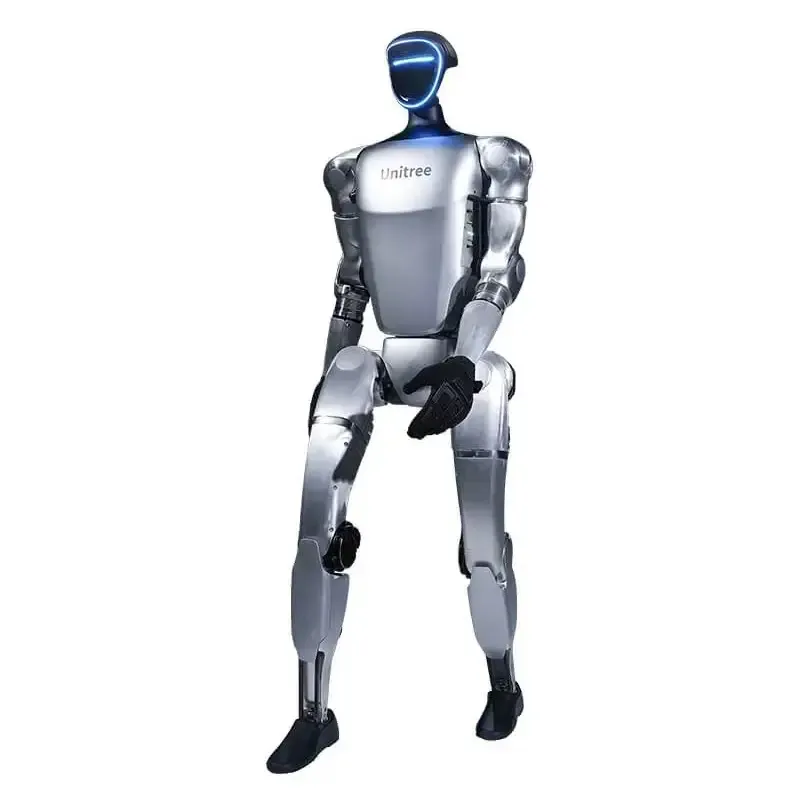
Unitree Robotics
Unitree G1
Model: G1
The Unitree G1 is the most affordable production humanoid you can order right now without a corporate sales conversation (Unitree's larger H1 and smaller R1 are also self-serve orderable; the G1 is the value pick). Unitree shipped 5,500+ units in 2025 and is targeting 20,000 in 2026. The G1 is a research and early-industrial platform, not a household appliance, but it is genuinely purchasable, ships within weeks via RobotShop and the Unitree official store, and even appears on Amazon. The tradeoff: ~2-hour battery life, no integrated AI model for general tasks, and a product built for labs and developers, not consumers.
Figure AI
Figure 03
Model: Figure 03
Figure AI has cleared the hardest gap in the category: from prototype to production at scale. Their BotQ facility went from 1 robot/day to 1 robot/hour in under 120 days, with 350+ Figure 03 units delivered as of April 2026. The BMW Spartanburg deployment (Figure 02) contributed to 30,000+ vehicles. Figure 03 is now expanding to additional BMW plants and is structured as a Robot-as-a-Service commercial contract at roughly $25/hour. Not a unit you can buy, but the closest thing to a commercially proven humanoid in the West. Figure is also targeting residential use cases and has built field-service infrastructure for home deployments.
1X Technologies
1X NEO
Model: NEO
Norwegian startup 1X is the only company with open consumer preorders at a published price with a US delivery commitment in 2026. The NEO is purpose-built for the home, lighter and quieter than industrial humanoids, with privacy features including configurable no-go zones and face blurring. Day-1 tasks: door operation, fetching items, basic household assistance. 1X has raised significant backing including from OpenAI. The honest caveat: this is an early-access product from a startup, not a mature appliance. Buyers are funding the product's development as much as receiving a finished product.
Apptronik
Apollo
Model: Apollo
Apptronik Apollo is deployed at Mercedes-Benz factories and GXO Logistics warehouses, backed by Google and Mercedes-Benz, and has raised $935M+ in its Series A. Apollo CEO Jeff Cardenas has stated a goal of under $50,000 per unit, but that's a target, not a current price, and units are not available outside enterprise partnerships. The $520M raise in February 2026 (at a $5.5B valuation) suggests serious commercial momentum. Most credible for large-company logistics and manufacturing procurement, not individual purchase.
Tesla
Optimus Gen 3
Model: Optimus Gen 3
Tesla has over 1,000 Optimus Gen 3 robots working in its own factories as of early 2026: battery sorting, parts handling, quality inspection. This is the largest internal humanoid fleet deployed by any company. But it is emphatically not available externally. Tesla has not opened preorders, has not confirmed a B2B sales program, and analyst estimates for external availability range from late 2027 (limited B2B) to 2028+ (broad commercial). The $20K consumer price target from Musk is aspirational; most analysts put realistic consumer pricing at $30K+ when it eventually ships. The manufacturing story is real; the purchase story is not yet.
Boston Dynamics
Atlas (Electric)
Model: Atlas (Electric)
Boston Dynamics' electric Atlas, distinct from the retired hydraulic Atlas, began shipping commercial units in 2026. All 2026 production is committed to Hyundai's Robotics Metaplant Application Center (RMAC) and Google DeepMind; additional customers are not expected until 2027. Atlas carries the most sophisticated locomotion and manipulation capabilities of any shipping humanoid, but it is inaccessible to anyone outside Boston Dynamics' existing enterprise pipeline, and pricing estimates vary wildly. The most interesting robot in the category for capability; the least accessible for procurement.
The honest framing for 2026
Humanoid robots are no longer exclusively lab demos. Some are on factory floors doing real work with documented KPIs. One is available for consumer preorder with a published price and a delivery timeline. But the gap between “this is real” and “you can buy one and use it at home” is still large, and the marketing around this category consistently obscures that gap.
This guide tries to close it. For each major platform we answer the same three questions: Is it shipping? To whom? At what price and under what terms?
What’s actually shipping to real customers
Figure 03 is the clearest commercial story in 2026. Figure AI’s BotQ manufacturing facility went from producing one robot per day to one per hour in under 120 days, and has delivered over 350 Figure 03 units as of late April 2026 (Figure AI, April 2026). The prior generation, Figure 02, completed an 11-month BMW Spartanburg deployment that contributed to 30,000+ X3 vehicles, running 1,250+ hours with 90,000+ parts loaded (Figure AI, November 2025). These are not demo numbers. They are production KPIs with documented cycle times and placement accuracy requirements. The commercial model is Robot-as-a-Service at roughly $25/robot-operating-hour, not a unit you can purchase outright. Figure is not available for individual or small-business procurement.
Apptronik Apollo is deployed at Mercedes-Benz assembly plants and GXO Logistics warehouses, with Google and Mercedes as lead backers. A $520M Series A raise in February 2026, bringing total financing above $935M, reflects genuine enterprise traction. Apollo’s CEO has cited a target unit price under $50,000, but that is a goal, not a current price, and procurement requires an enterprise partnership discussion, not a product page.
Boston Dynamics Atlas (electric) began shipping commercial units in 2026. All current production is committed to Hyundai’s Robotics Metaplant Application Center and Google DeepMind. Additional customers are not expected to be onboarded until 2027. Pricing is not publicly disclosed; analyst estimates range widely, from roughly $150,000 to over $400,000 per unit.
Unitree G1 is the outlier: a full-size bipedal humanoid you can order online today, without a sales call, starting at approximately $16,000. Unitree shipped over 5,500 units in 2025 and targets 20,000 in 2026, and the G1 is available through the Unitree official store, RobotShop, and Amazon. EDU configurations with expanded degrees of freedom run from $43,900 to $73,900. The G1 is a research and developer platform, not a household robot, but it is genuinely, immediately purchasable.
The consumer preorder story: 1X NEO
1X NEO is the only humanoid with open consumer preorders at a fixed price and a US delivery promise in 2026. The Norwegian company, backed partly by OpenAI, is asking $200 to reserve a place in line toward a $20,000 purchase price (or a $499/month subscription). First deliveries are targeted for US early-access customers in 2026, with broader markets in 2027 (1X order page).
The NEO is purpose-designed for the home, lighter and quieter than industrial platforms, with privacy features including configurable no-go zones and the ability to blur faces of people it interacts with. Stated Day 1 capabilities are conservative and honest: opening doors, fetching items, turning off lights. The company is not claiming general domestic labor.
The important caveat: 1X is a startup shipping an early-access product. Buyers at this price and this stage of development are effectively participating in the product’s development cycle. That is not a dealbreaker if you understand what you’re getting, but it is meaningfully different from buying a consumer appliance.
The Tesla Optimus situation
Tesla has more humanoid robots working in production environments than any other company: over 1,000 Optimus Gen 3 units deployed across its own factories as of early 2026, performing battery sorting, parts handling, and quality inspection. The Fremont facility has been partially converted for Optimus Gen 3 manufacturing.
What Tesla does not have: an external sales program, open preorders, or a confirmed B2B commercial offering for non-Tesla customers. As of mid-2026, Optimus is internal only. Elon Musk’s stated long-term consumer price target of under $20,000 is aspirational; analysts generally place realistic external availability at late 2027 for limited B2B pilots, with broader consumer access in 2028 at the earliest. Third-party sites offering to “pre-sell” Tesla Optimus are not affiliated with Tesla.
The manufacturing achievement is real and significant. The availability story is not.
What separates the commercial leaders from the demos
A useful framework: the difference between a robot that performs in controlled demos and one that performs commercially is the KPI conversation. Figure’s BMW deployment had three measurable targets: cycle time (84 seconds total, 37 seconds load time), placement accuracy (>99% per shift), and interventions per shift (goal: zero). Those are the numbers that make a humanoid deployment a finance-defensible operating line rather than an R&D experiment.
Most humanoid companies in 2026 are still on the demo side of that line. The ones with real commercial deployments, Figure, Apptronik, Agility (at Amazon and GXO), and Boston Dynamics (at Hyundai), are the ones who have sat through those KPI negotiations with industrial customers and delivered.
The consumer side of the market is even earlier. The 1X NEO’s Day 1 task list (door operation, fetching, lights) is conservative not because of limited technology but because 1X has correctly identified that a household use case requires reliability across a chaotic, unpredictable environment that even the best factory robots struggle with. Getting a robot to load a car part in a structured fixture at 99% accuracy is genuinely easier than getting one to reliably put a glass in the dishwasher across 1,000 different kitchens.
Who should be watching this space vs. acting on it
Watch, don’t buy yet: Anyone looking for a household assistant that works like a capable human. That product does not exist in 2026. The 1X NEO is the most credible attempt, and even 1X frames first-year use as a collaboration between user and product.
Consider now, with clear eyes: Researchers, developers, and robotics labs: the Unitree G1 is a legitimate and accessible platform at its price point. Large enterprises in automotive, logistics, and manufacturing: Figure, Apollo, and Boston Dynamics Atlas are operational and investable, if not purchasable off-the-shelf.
The price to watch: When a full-size bipedal humanoid with a general AI model crosses below $10,000, the consumer calculus changes. That is not a 2026 event. The G1 at $16,000 is the current floor, and it is a developer tool.
The vaporware filter
Not every humanoid company with a slick video is a company with a shipping product. The signal to look for: documented commercial deployment with named customers and production KPIs. Figure, Apptronik, Agility, Boston Dynamics, and Unitree have that. Many others do not. A convincing demo reel and a waiting list are table stakes in this category, not evidence of commercial readiness.
Frequently asked questions
Can a regular consumer actually buy a humanoid robot in 2026?
What can today's humanoid robots actually do reliably?
Is Tesla Optimus the most advanced humanoid?
Why are humanoid robots so expensive?
What about companies like Agility (Digit) and UBTECH?
When will a humanoid robot be available at a 'normal' consumer price?
Sources
Every claim in this guide that isn't first-person experience is traceable to one of the sources below. URLs verified at publication; some may rot. Let us know if so.
- Ramping Figure 03 Production · Figure AI, April 29, 2026Primary source. BotQ facility producing 1 Figure 03/hour; 350+ units delivered; 24x throughput improvement in under 120 days.
- F.02 Contributed to the Production of 30,000 Cars at BMW · Figure AI, November 19, 2025Primary source. Figure 02 BMW Spartanburg deployment results: 90,000+ parts loaded, 1,250+ hours runtime, contributed to 30,000+ X3 vehicles. KPIs documented: 84-second cycle time, >99% placement accuracy target.
- Unitree G1: Official Product Page · Unitree Robotics, 2026Primary source. G1 available for direct purchase, prices listed in USD. Ships within weeks.
- Unitree G1 Humanoid Drops for $16,000, Upending the Robotics Market · RoboHorizon, April 2026Market context on Unitree G1 pricing and 2026 shipment targets (20,000 units). IPO context ($610M Shanghai filing).
- 1X NEO Home Robot: Order Page · 1X Technologies, 2026Primary source. $200 deposit, $20,000 purchase or $499/month subscription. 2026 US delivery commitment.
- NEO humanoid designed for household use, available for preorder · The Robot Report, 2026Independent coverage of 1X NEO preorder launch, pricing, and US delivery timeline.
- Apptronik raises $520M to produce humanoid Apollo robot commercial deployments · SiliconANGLE, February 11, 2026$520M raise at $5.5B valuation; total Series A exceeds $935M. Google and Mercedes-Benz as lead backers. Apollo deployed at Mercedes-Benz factories and GXO Logistics.
- Apollo: Apptronik Product Page · Apptronik, 2026Primary source. Product overview, deployment capabilities, partnership context.
- CES 2026: Boston Dynamics Set to Ship First Atlas Humanoids This Year · Automate.org / A3, January 2026Boston Dynamics electric Atlas beginning production in 2026; first units to Hyundai RMAC and Google DeepMind. Additional customers not until 2027.
- Tesla Optimus Price & Availability 2026: What We Know · Silicon Valley Robotics Center, 2026Synthesis of Tesla Optimus deployment status, pricing claims, and availability timeline. Notes 1,000+ internal units deployed; no external sales as of mid-2026.
- Humanoid Robotics 2026: Figure, Optimus, 1X Commercial Reality · VaaSBlock, 2026Market survey of commercial status across major humanoid platforms; pricing context for enterprise deployments.
- Figure AI Stock: $39B Valuation. Is It a Buy? · TSG Invest, 2026Financial context on Figure AI valuation, IPO outlook, and commercial deployment revenue structure.